


What drives upland sandpiper population trends?
Each spring, upland sandpipers migrate from South America to a large portion of Canada and the United States for breeding. Intriguingly, this bird’s breeding population patterns are complex, with varying trends across their range. Prairie conservationists have a keen interest in gaining a deeper understanding of landscape factors driving these varied trends. This understanding is important not only for conserving this grassland shorebird itself, but also other midcontinental shorebirds and grassland birds who share the same landscapes. Overall, the breeding populations of shorebirds and of grassland birds have dramatically declined in North America in recent decades. To help fill the gap in understanding, Andres Rosales, a University of Saskatchewan MSc student, conducted a study to analyze land cover changes – especially the conversion of grasslands to agricultural crops – as a potential driver of the upland sandpiper’s local breeding population trends. His study was guided by Environment and Climate Change Canada’s Dr. Kirsty Gurney and Dr. Ann McKellar.
View article.
Science Matters. Through our Science Fund, the Alberta NAWMP Partnership supports research towards achieving our vision of maintaining healthy prairie, parkland and boreal landscapes that support sustainable bird populations and provide ecological and economic benefits to society.
We are grateful to everyone who contributes to this work and for their willingness to enable us to profile their research through our Science Stories Series. For additional Science Stories, visit https://abnawmp.ca/science/#science-stories. For further information regarding their work, contact the researchers directly or email the Alberta NAWMP Partnership Coordinator.
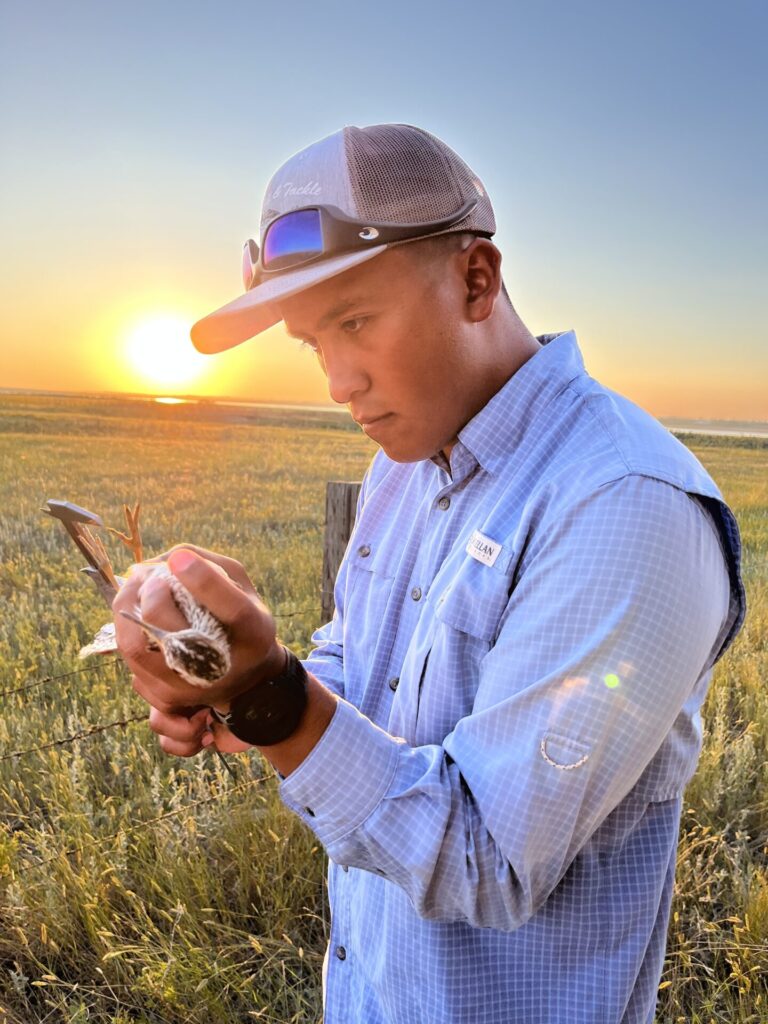
University of Saskatchewan graduate student Rosales takes measurements of an upland sandpiper.
credit: Sydney Marie Jones, University of Saskatchewan